

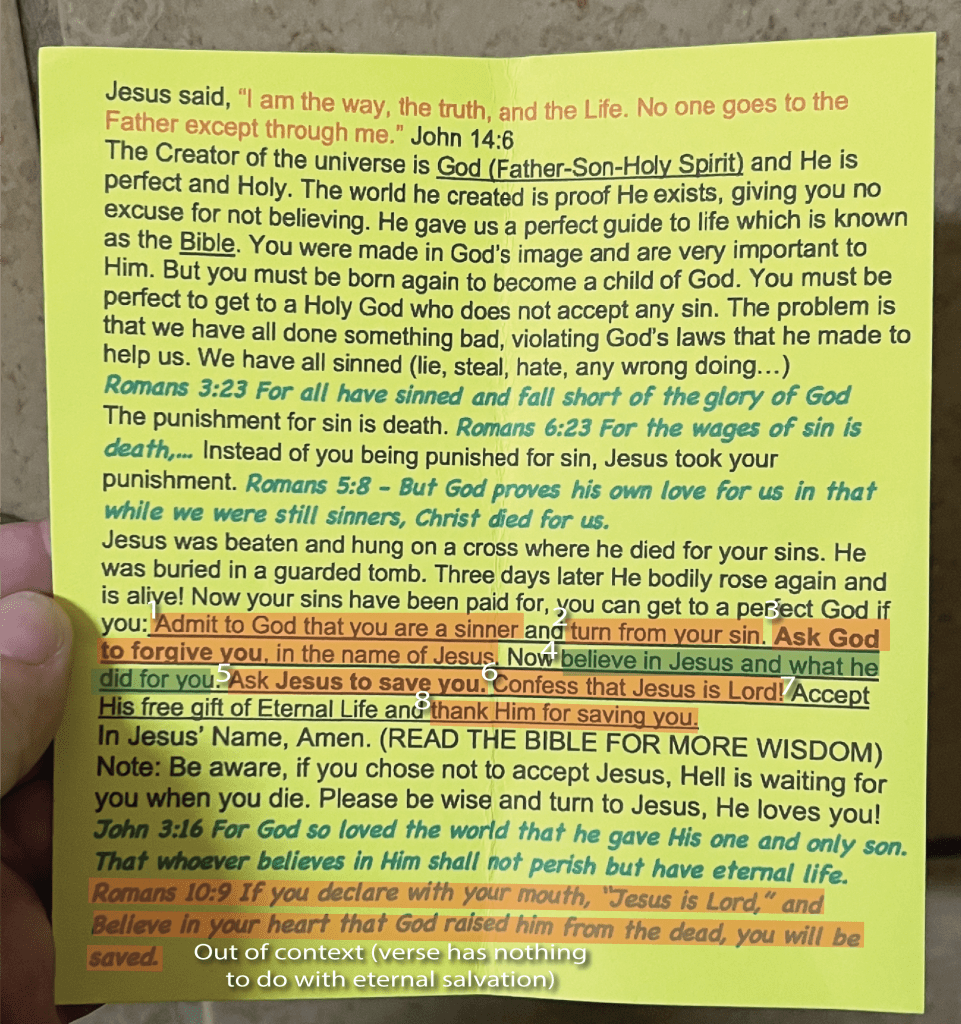
While visiting my hometown for Christmas I came across a “Gospel Tract” in the bathroom of a local store. I am all for leaving stuff in public places for people to hear the good news of Christ, so I picked it up. As someone who makes a living doing marketing and graphic design, I was a bit turned off by the look of it. Just a bunch of multicolored text on a neon green piece of paper. But I decided to read it anyways. The majority of it was solid biblical truth telling how we are all sinners in need of a savior and that Christ was that savior who would save us from our sins and offers us eternal life. It provided Bible verses to back those claims up and they were all in context and accurate. When it got to the “how to receive eternal life and forgiveness of sins” part, that is when it went off the rails. I have no doubt that this was made with the best intentions by someone who loves the Lord and wants lost people to be saved, but they obviously bought into some unbiblical doctrine that takes scripture out of context and appears to promote a works-based salvation. I decided to take a picture of this tract before I threw it in the garbage so people wouldn’t read it and be led astray. So without further ado, let’s dive in and analyze this.
What It Gets Right
As I said, the top half of this tract is correct.
- Jesus is the way, the truth, and the life, and nobody can come to the Father except through Him.
- He has given us all proof of His existence through His creation. Paul writes in Romans 1:20 that “God’s invisible qualities – His eternal power and divine nature – have been clearly seen, being understood from what has been made, so that people are without an excuse”.
- The Bible was written for us on how to live and how to have a relationship with Him.
- We are made in His image and important to Him.
- We must be born again to become a child of God.
- You have to be perfect to get to a Holy God and He does not accept any sin.
- We have all sinned and fallen short of His glory.
- The wages of sin is death and that Christ died for us because He loves us.
- He died a brutal death on a cross for us.
- Your sins have been paid for.
What It Gets Wrong
The tract then goes on to present a formula by which you must follow in order to get to a perfect God. This formula consists of 8 things one must do in order to be saved. Only one of which is correct, and another is automatic.
- Admit to God that you are a sinner
In order to be saved one has to realize that they need saving. They have to realize that they are a sinner. A simple mental realization and acceptance of this fact is all that is needed. While it is good to admit your sins to God, one isn’t required to have a conversation with God in which you admit to Him that you are a sinner in order to be saved. - Turn from your sins
Turning from or “repenting” of your sins is a great thing that all Christians should do daily and almost always requires much active effort on our part. However, it is not required for us to receive eternal life. It is part of sanctification, not justification. In Jonah 3:10, it says “…God saw what they (Ninevites) did and how they turned from their evil ways”. In this passage it is shown that God clearly sees turning from sin as an action that people do, contrary to how many theologies claim turning from sin is not a work. If God sees it as a work, then we should too. It is also important to point out that it was a work that the Ninevites did AFTER they believed. There are passages in the New Testament that tell people to “repent and believe” but those are mostly talking to a Jewish audience and given as a requirement for the Kingdom and temporal deliverance, not eternal life. As Bob Wilkin puts it, “Since John 3:16 mentions only faith in Christ, not repentance, it should be clear that repentance is not a condition of regeneration and that faith in Christ is not a work (cf. Eph 2:8-9). In fact, repentance is not found even once in John’s Gospel, the only evangelistic book in the Bible (John 20:30-31). - Ask God to forgive you, in the name of Jesus
Again, it is great to ask God to forgive you, and you should do that, just as you should always ask for forgiveness to anyone you have wronged, but the action of asking God to forgive you is not required to receive eternal life. He forgives us when we believe in Him, whether or not we actually ask him to do it or not. - Believe in Jesus and what He did for you
This is THE ONLY one in this list that is a requirement for eternal salvation. As Bob Wilkin pointed out, the book of John is the only book in the Bible with the stated purpose of evangelism, the only book written specifically to unbelievers to convince them of the truth of Christ and to believe it. Over 72 times in that book alone belief is listed as the only requirement to receive everlasting life. To “believe”/”trust in”/”have faith in” (same Greek word) simply means “to think to be true, to be persuaded of”. This isn’t a work or action either. You hear evidence for something and you either believe it to be true or you don’t. In this case, you either believe that Christ is the savior who paid for your sins or you don’t. In Acts 16:30 & 31 the Philippian jailer asks Paul and Silas what he must do to be saved. They reply with “believe in the Lord Jesus Christ and you will be saved”. - Ask Jesus to save you
Unbelievers are never told to ask Jesus to save them. He has already done the work required to save us all, eternal salvation becomes a reality to us the moment we believe. - Confess that Jesus is Lord
As with most of the other things in this list, verbally confessing that Jesus is Lord is a great thing and all Christians should do this because after all, that is what they believe. However, not once in scripture are unbelievers called to verbally confess that Jesus is Lord in order to receive eternal life. To speak is an action that we do, as easy as it is to speak words, it is still something that we must consciously choose to do. And if it is something that we do, then it is something we can take credit for and boast about. Additionally, if this was a requirement for eternal life, then anybody who was mute wouldn’t stand a chance of going to heaven. - Accept His free gift
This is an odd one in this list because it is a passive and automatic action. We accept or receive His free gift when we simply believe. We receive the righteousness of Christ the moment we believe in Him. His righteousness is automatically imputed to our account.
I do find it quite ironic that the author of this tract has the audacity to correctly refer to eternal life as a “free gift” in the middle of listing multiple things that one must do to receive it that negate it being free. Eternal life is either by grace (a free undeserved gift) or it isn’t. It cannot be both free and costly. As Paul points out in Romans 11:6, “And if by grace, then it cannot be based on works; if it were, grace would no longer be grace”. As Lucas Kitchen points out, Free ≠ Costly. - Thank Him for saving you
Thanking God is something we should always do and should be an automatic response from us, just as one would say thank you after being given a birthday present. However, thanking him in no way contributes to whether we spend eternity with Him or not.
As you can see, most of these list items are all great things that all Christians should do, and I am in no way saying we shouldn’t do them. I’m simply pointing out that biblically none of these, except for believing, have anything to do with receiving eternal life. If these actions and efforts on our part are presented as things we must do in order to receive eternal life, then this is a completely different gospel than what is taught in the New Testament and it does not lead to eternal life. This “gospel that is no gospel at all” is quite similar to what the first century Galatian church was tricked into believing after Paul left them. He dedicated an entire letter to them to set them straight and tells them that anyone who teaches such a false gospel is under a curse.
“I am astonished that you are so quickly deserting the one who called you to live in the grace of Christ and are turning to a different gospel— which is really no gospel at all. Evidently some people are throwing you into confusion and are trying to pervert the gospel of Christ. But even if we or an angel from heaven should preach a gospel other than the one we preached to you(eternal life by grace through faith in Christ), let them be under God’s curse! As we have already said, so now I say again: If anybody is preaching to you a gospel other than what you accepted, let them be under God’s curse!”
-Galatians 1:6-9
Finally, the author of this tract quotes John 3:16, which is 100% true and really should have been enough to explain how to receive eternal life. It is extremely clear and straight forward. But then the author contradicts John 3:16 by inserting Romans 10:9 completely out of context. Romans 10 is speaking to believers and is not an evangelistic passage. The following verse makes this clear that the “salvation” in view here is not eternal salvation. “For with the heart one believes unto righteousness, and with the mouth confession is made unto salvation”. Paul makes its clear that belief/faith is what gives us eternal life (righteousness) and that confession with the mouth gives us salvation/deliverance. By showing this distinction, Paul obviously means something different by the two. Wilkin points out “When Paul wishes to speak of eschatological salvation in Romans, he speaks of justification or righteousness (Romans 3:21-4:25). The justification section in Romans is Rom 3:21–4:25. Not once in that section does Paul use the words save or salvation. But he uses the words justify (6 times) and righteousness (11 times) a total of 17 times in that section. In Romans, Paul never equates justification with salvation. They are distinct.”
Believing and verbally declaring is similar to “calling on the name of the Lord” which is a reference to Joel 2:28 that is used later in this chapter. With the inclusion of that reference and the mention that he is talking about Israel, it is made clear that this is referring to temporal salvation from troubles here on earth. (I covered this in a previous article).
Sadly, messages like this tract are quite common to hear in churches on Sunday mornings across the US and I have personally seen how it has confused the members of those churches and caused doubts in salvation. It causes people to look to and rely on their own works rather than the finished work of Christ on the cross and His free gift to us to receive eternal life. It essentially denies His grace.
As believers in Christ and ambassadors for Him, it is our job to be clear when presenting the gospel and not confusing. God is not a God of confusion. He made eternal life free and accessible to all and one can receive that life if they simply believe in Jesus Christ. With all the confusion already in the world, the last thing we need to do is to complicate and confuse the most important truth of all time: the Gospel. Keep it simple my friends, keep it simple.
 The View Point